
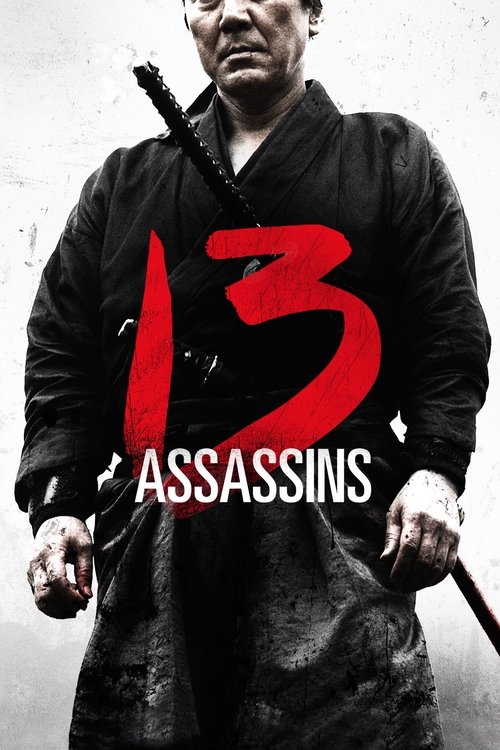
13 Assassins (2010)
Directed by Takashi Miike
A bravado period action film set at the end of Japan's feudal era in which a group of unemployed samurai are enlisted to bring down a sadistic lord and prevent him from ascending to the throne and plunging the country into a war-torn future.
24 connections found
View:
24 films that influenced 13 Assassins
What critics say influenced 13 Assassins



This film draws on so many precedents that I can only list a few: Unforgiven for the grim revenge tale with no limits set on that revenge; Seven Samurai for the story of assembling a motley crew in order to achieve a mission; Lone Wolf and Cub for the theme of the few battling the many and for the almost absurd excesses of the final battle; Ran for the attention to period feel and detail; Butch Cassidy and the Sundance Kid for the theme of people stuck in the ethos of a past era while the world has moved on; and any number of exploitation horror films (the Saw franchise, The Human Centipede) for the grotesque mutilations that are depicted in 13 Assassins.
Film buffs tend to forget, with the half century or more of hoopla surrounding “Seven Samurai” and “Yojimbo,” that samurai pictures were and remain the equivalent of Westerns in Japan — formula films with time-honored motifs, action beats and archetypes.
So it remained a question whether Miike’s over-the-top sensibility could connect with the very rigid forms of samurai cinema, set forth by classic films like “Seven Samurai.”
The plot has received its fair number of comparisons to Kurosawa Akira's legendary Seven Samurai , which I think tells us more about American film critics' relationship with Japanese cinema than it does about 13 Assassins, though I take it as read that Miike was not exempting Kurosawa from his catch-as-catch-can approach.
Those walking into “13 Assassins” expecting something sick and twisted, however, might be surprised to discover that it’s one of Miike’s most reserved films to date – a classic samurai tale that, while very similar to Akira Kurosawa’s “Seven Samurai” in spirit, is actually a remake of the 1963 film by Eiichi Kudo.
Much more consistent is 13 Assassins , a surprisingly classical epic in the Seven Samurai mode by Japanese bad boy Takashi Miike.
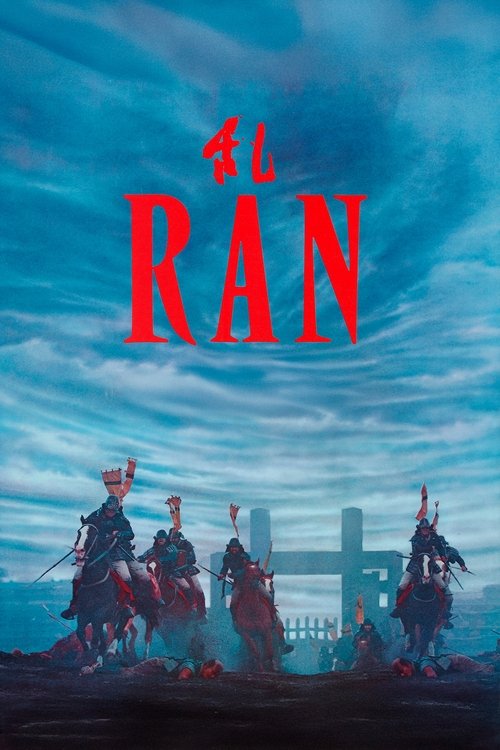
This film draws on so many precedents that I can only list a few: Unforgiven for the grim revenge tale with no limits set on that revenge; Seven Samurai for the story of assembling a motley crew in order to achieve a mission; Lone Wolf and Cub for the theme of the few battling the many and for the almost absurd excesses of the final battle; Ran for the attention to period feel and detail; Butch Cassidy and the Sundance Kid for the theme of people stuck in the ethos of a past era while the world has moved on; and any number of exploitation horror films (the Saw franchise, The Human Centipede) for the grotesque mutilations that are depicted in 13 Assassins.
As a long time fan of Jidaigeki {Edo period} samurai lore from Kurosawa {Throne of Blood (1957), Yojimbo (1961), Ran (1985)}, to Okamoto {Sword of Doom (1966), Kiru! (1968)}, and Misumi and Kitano�s tales of the blind masseur with samurai honour {The Tale of Zatoichi/Zatoichi (1962/2003)}, I was excited to see Miike try his hand at a serious samurai film.
The shadow of the mighty Japanese filmmaker Akira Kurosawa (Yojimbo, Ran) looms large over mini-epic 13 Assassins.
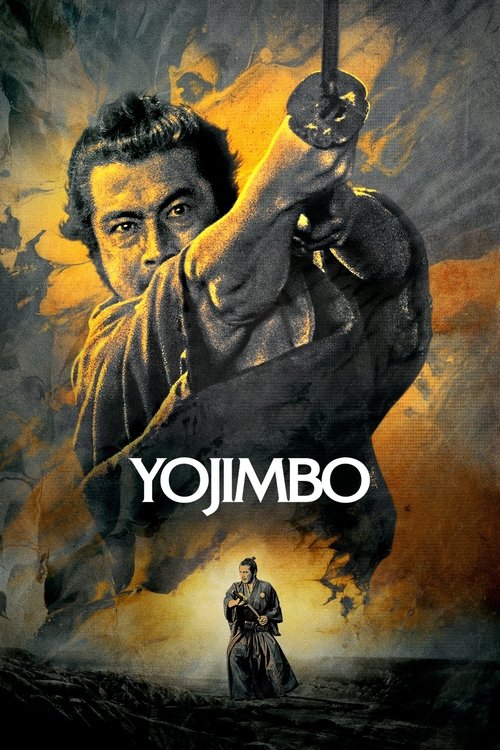
The shadow of the mighty Japanese filmmaker Akira Kurosawa (Yojimbo, Ran) looms large over mini-epic 13 Assassins.
It’s also a homage to the samurai genre, especially Seven Samurai , Yojimbo and Sanjuro; at the screening I saw on Sunday night fans whopped with delight whenever they recognised a gesture, a shot or a camera move from any of these classic Kurosawa movies!
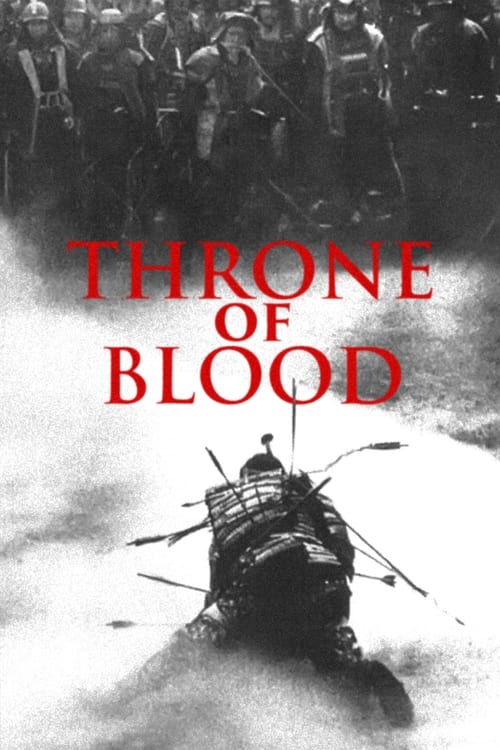
As a long time fan of Jidaigeki {Edo period} samurai lore from Kurosawa {Throne of Blood (1957), Yojimbo (1961), Ran (1985)}, to Okamoto {Sword of Doom (1966), Kiru! (1968)}, and Misumi and Kitano�s tales of the blind masseur with samurai honour {The Tale of Zatoichi/Zatoichi (1962/2003)}, I was excited to see Miike try his hand at a serious samurai film.

But I wonder if it more closely resembles another end-of-an-era picture, Sam Peckinpahs The Wild Bunch.
So too did Sam Peckinpah’s “The Wild Bunch” and Spielberg’s “Saving Private Ryan.”
13 Assassins, Takashi Miike's costume-period retro-cross-cultural updating of Sam Peckinpah's The Wild Bunch (and more horizontal homage to obvious antecedents by countrymen Kurosawa, Kobayashi, and Chushingura), initially seems a surprise choice for someone who's made his name (80+ times in the last twenty years) with transgressive, flamboyantly outré Yakuza and horror pictures.
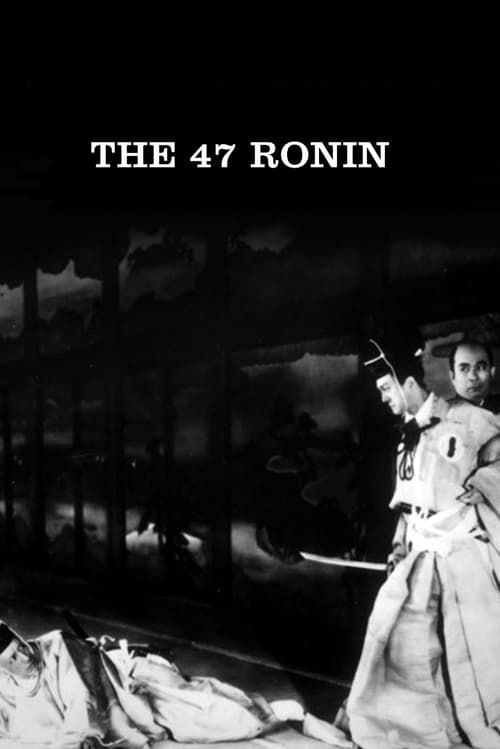
Visually and narratively, 13 Assassins reflects back to films at least as far apart in time and disparate in tone and theme as Mizoguchi Kenji's 1941 The 47 Ronin and Kobayashi Masaki's 1962 Harakiri (which Miike remade immediately following this film - redundantly, given how much Kobayashi influence there would appear to be in every inch of 13 Assassins).
Visually and narratively, 13 Assassins reflects back to films at least as far apart in time and disparate in tone and theme as Mizoguchi Kenji's 1941 The 47 Ronin and Kobayashi Masaki's 1962 Harakiri (which Miike remade immediately following this film - redundantly, given how much Kobayashi influence there would appear to be in every inch of 13 Assassins).
Advertisement
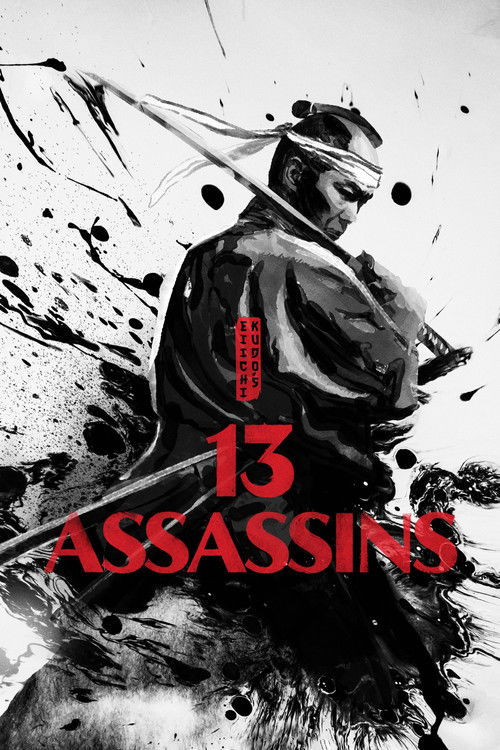
After the flop of Takashi Miike?s previous U.S. release, the jokey take-off Sukiyaki Western Django, this unpredictable non-schooled Japanese filmmaker flies even further from his usual corrupt present-day setting with 13 Assassins/Jûsan-nin no shikaku, which goes back to the mid-nineteenth century end of the Tokugawa Edo period.
The film serves up a remake of Eichi Kudo’s 1963 black-and-white movie, "Jûsan-nin no shikaku."
Ostensibly a remake of Eiichi Kudo's 1963 film Jûsan-nin no shikaku, Miike's version takes us to the year 1844, in which the chaotic, incessant warfare of Japan's feudal era has long since given way to the uneasy central control and iron-fisted cruelties of the Tokugawa Shogunate.
After the world premiere of 13 Assassins (Jûsan-nin no shikaku) in competition, critics hitherto hostile to the work of the prolific Japanese director Miike Takashi suddenly started to rave about the Kurosawa-like classicism of his new sword-fighting spectacular.
This film draws on so many precedents that I can only list a few: Unforgiven for the grim revenge tale with no limits set on that revenge; Seven Samurai for the story of assembling a motley crew in order to achieve a mission; Lone Wolf and Cub for the theme of the few battling the many and for the almost absurd excesses of the final battle; Ran for the attention to period feel and detail; Butch Cassidy and the Sundance Kid for the theme of people stuck in the ethos of a past era while the world has moved on; and any number of exploitation horror films (the Saw franchise, The Human Centipede) for the grotesque mutilations that are depicted in 13 Assassins.

Calling up Kurosawa and Masaki Kobayashi and their cowboy-genre disciples Leone, Sturges, Pekenpagh and Aldrich, Miike?s new theatrical release is writer Daisuke Tengan?s reworking of a Kaneo Ikegami script for Eiichi Kudo?s 1963 same original title rendered in English as Samurai Assassins (not to be confused with Samurai Assassin, the 1965 Kihachi Okamoto vehicle for Toshiro Mifune).
As a long time fan of Jidaigeki {Edo period} samurai lore from Kurosawa {Throne of Blood (1957), Yojimbo (1961), Ran (1985)}, to Okamoto {Sword of Doom (1966), Kiru! (1968)}, and Misumi and Kitano�s tales of the blind masseur with samurai honour {The Tale of Zatoichi/Zatoichi (1962/2003)}, I was excited to see Miike try his hand at a serious samurai film.
Advertisement
Once fortified in a montage reminiscent of “The Seven Samurai” and its Western variant, “The Magnificent Seven,” this “town of death” becomes the site of an amazing 40-minute pitched battle that utilizes sword, arrow, spear, explosive, slingshot and ‒ here’s a new one ‒ burning bull.

Miike Takashi’s 13 Assassins (Japan, 2011), a kind of outlaw The Seven Samurai by way of The Dirty Dozen set at the sunset of the Shogunate and the samurai era, is something different from Japan’s maverick auteur Miike: a startlingly traditional samurai action piece that shows that he can indeed color between the lines.
To adapt "Spinal Tap's" line, this one turns it up to 13. Companion viewing: "Seven Samurai," "Shadows in the Palace," "Battle of Wits," "The Dirty Dozen"…
The rumors are true: Miike Takashi’s 13 Assassins, a kind of outlaw The Seven Samurai by way of The Dirty Dozen set at the sunset of the Shogunate and the samurai era, is a startlingly traditional samurai action piece that shows that Miike can indeed color between the lines.