
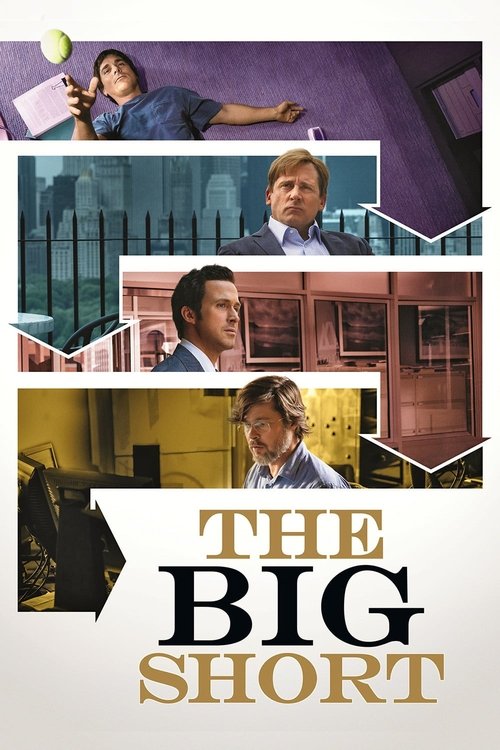
The Big Short (2015)
Directed by Adam McKay
The men who made millions from a global economic meltdown.
48 connections found
View:
48 films that influenced The Big Short
What critics say influenced The Big Short
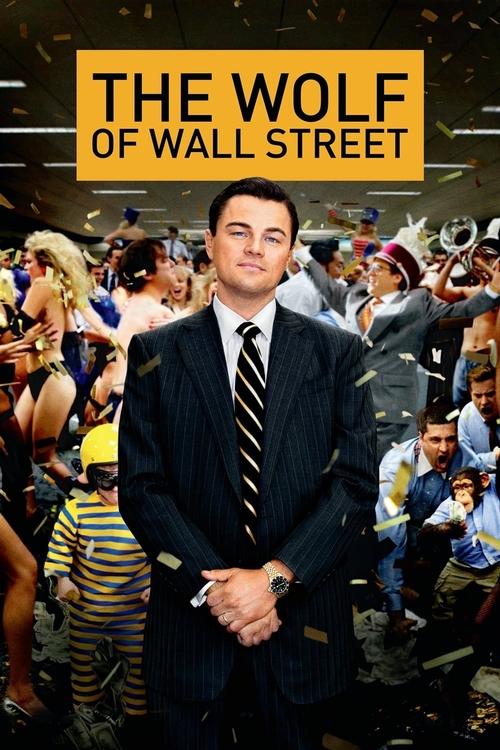


Based on a best-selling book by Michael Lewis about folks who anticipated the financial crisis of 2008, “The Big Short” is the film that “The Wolf of Wall Street” wanted to be.
And, while it deals with the unchecked recklessness of the financial sector, it's not like 2013's The Wolf of Wall Street.
While there is a certain undeniable fascination in watching the so-called experts go down while a few visionary mavericks escape on self-made lifeboats, you can never escape the thought that Paramount probably made this film only because of the success of The Wolf of Wall Street two years ago and then recall how much better made and more entertaining that was than what's onscreen here.
Cut to Robbie—whom many viewers will have last seen in “The Wolf of Wall Street”—swathed in foam and holding a glass of champagne.
While "Short" lacks the naughty bravado of "The Wolf of Wall Street," Martin Scorsese's skinny dip into suit-and-tie avarice, it's still a feisty, rattling good film that likely will make you spitting mad.
That approach works until McKay’s control begins to slip: Unlike “ The Wolf of Wall Street ” (which is explicitly invoked in one of those celebrity cameos), “The Big Short” can’t exactly be accused of celebrating the greedy bro culture it’s indicting.
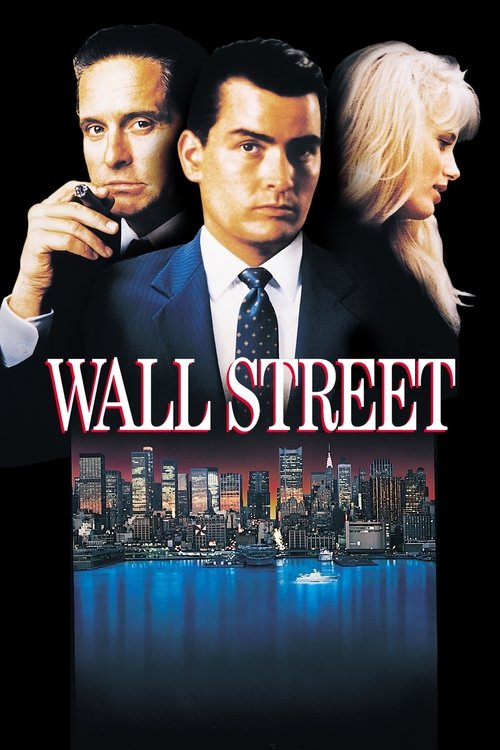
From Wall Street (1987) to Margin Call (2011), from American Psycho (2000) to, of course, Wolf of Wall Street (2013), filmmakers' answers to that question have ranged all over the map.
Like thematic predecessors such as Wall Street, The Big Short is all about greed and making money.
The great American tradition of filling one’s pockets with other people’s money has inspired milestones from “Glengarry Glen Ross” to “Ocean’s Eleven,” “Wall Street” and “The Wolf of Wall Street.”
Unlike the slick suits and killer sheen of Oliver Stone’s Wall Street , this is a world of chaos and disorder filled with misfits who understand numbers more than people; from Christian Bale’s Michael Burry, a socially awkward heavy-metal enthusiast who dreams up the credit default swaps that enable him to “short” the housing market, to Steve Carell’s bereaved and fractured Mark Baum (a character inspired by the real-life Steve Eisman) who balances moral outrage and repressed self-loathing as he swims with sharks in the cesspool of the financial market.
Since his baptism of fire on such teeming Oliver Stone hornets’ nests as JFK and Natural Born Killers, Corwin has worked selectively, adding two Terrence Malick epics to his resumé, and he cuts The Big Short with his usual instinct for allusive, propulsive storytelling, moving us along at a clip yet not too fast to process everything.
También, el director se apoya en el notable y frenético trabajo de edición de Hank Corwin (Natural Born Killers, 1994; The Tree of Life, 2011) y en la fotografía de Barry Ackroyd (The Hurt Locker, 2008; Captain Phillips, 2013) para proponer un constante tránsito que va desde los centros de negocios hasta las salas de juntas, pasando por las agitadas calles de Manhattan, las desoladas regiones de Florida y los centros nocturnos de Las Vegas, con la intención de informarle al espectador sobre las causas subyacentes de la inestabilidad económica, pero haciéndolo con irreverencia y frescura, sin recurrir al complejo academicismo o al pedestal solemne del análisis económico.
Since his baptism of fire on such teeming Oliver Stone hornets’ nests as JFK and Natural Born Killers, Corwin has worked selectively, adding two Terrence Malick epics to his resumé, and he cuts The Big Short with his usual instinct for allusive, propulsive storytelling, moving us along at a clip yet not too fast to process everything.
Based on Michael Lewis's 2010 bestselling book of the same name, McKay's film operates on a gambit as audacious — and as ultimately unsuccessful — as the one that J.C. Chandor risked in Margin Call (2011), which also centers on the economic catastrophe of seven years ago: Both ask viewers not only to empathize with but to find heroic obscenely overpaid finance workers.
“The Big Short” joins and compares favorably to other laud-worthy films about the tanking of the economy or the insane housing market, including the exceptional “Margin Call,” the anger-inducing documentary “Inside Job” and this year’s indie gem “99 Homes.”
Filmmakers looking to rectify this have already approached the story from a number of angles, from sober-minded documentary (“Inside Job”) to operatic boiler-room drama (“Margin Call”), but the route taken by “The Big Short” is by far the most radical, turning a dense economics lecture into a hyper-caffeinated postmodern farce, a spinach smoothie skillfully disguised as junk food.
A number of other films have been set against the financial collapse, including J.C. Chandor’s Margin Call (2011) and Ramin Bahrani’s 99 Homes (2015), as well as a host of outraged documentaries, but The Big Short does something unique in trying to dramatize the collapse itself and what led to it, rather than using it as a backdrop for character drama.
It's not, for example, like the 2010 documentary Inside Job.
“The Big Short” joins and compares favorably to other laud-worthy films about the tanking of the economy or the insane housing market, including the exceptional “Margin Call,” the anger-inducing documentary “Inside Job” and this year’s indie gem “99 Homes.”
Filmmakers looking to rectify this have already approached the story from a number of angles, from sober-minded documentary (“Inside Job”) to operatic boiler-room drama (“Margin Call”), but the route taken by “The Big Short” is by far the most radical, turning a dense economics lecture into a hyper-caffeinated postmodern farce, a spinach smoothie skillfully disguised as junk food.
McKay, best known for such comedies as Anchorman and Step Brothers, wants us to root for people who would be villains or dupes in other money movies, such as 99 Homes and Inside Job.
Seguro que algunos de vosotros ya habéis visto cintas como el notable documental ‘Inside Job’ o la apreciable ‘Margin Call’, pero aún faltaba por llegar ese título más accesible para que el público se interese en algo que sabe de antemano que va a provocar que acabe indignado.
Advertisement
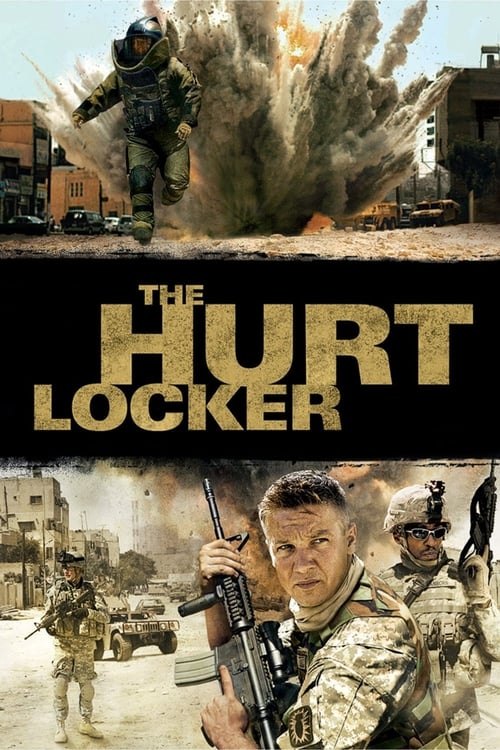
The thrills of the trading floor are correspondingly addictive, and the resulting dopamine high can be ethically dubious in the same way dramatized in The Hurt Locker; it's an open secret that plenty of bankers spend their free time skydiving or base jumping or (more probably) drinking and chasing a substance high.
While this shaggily framed comedy (shot by verite-DP Barry Ackroyd, nominated for "The Hurt Locker") avoids gloss and is packed with laughs—with multiple characters talking directly to the camera to explain what is going on, from "House of Cards"-style asides to long explanatory Brechtian footnotes such as Selena Gomez stacking chips in Vegas to define "synthetic CDOs," Anthony Bourdain making fish chowder out of three-day-old fish, and Margot Robbie sipping champagne in a bubble bath —this movie assumes we want to know what "really" happened to collapse the world economy.
Shot by Barry Ackroyd with the shaky-cam lensing he made famous in the Jason Bourne movies and “The Hurt Locker,” “The Big Short” winds up being a woozily punch-drunk assault on the senses, which makes it all the more remarkable when the actors manage to deliver sharp performances amid the circling bluebirds.
The antic camerawork is by Barry Ackroyd, whose work includes twelve films for Ken Loach, “United 93,” “The Hurt Locker” and “Anne Frank Remembered.”
También, el director se apoya en el notable y frenético trabajo de edición de Hank Corwin (Natural Born Killers, 1994; The Tree of Life, 2011) y en la fotografía de Barry Ackroyd (The Hurt Locker, 2008; Captain Phillips, 2013) para proponer un constante tránsito que va desde los centros de negocios hasta las salas de juntas, pasando por las agitadas calles de Manhattan, las desoladas regiones de Florida y los centros nocturnos de Las Vegas, con la intención de informarle al espectador sobre las causas subyacentes de la inestabilidad económica, pero haciéndolo con irreverencia y frescura, sin recurrir al complejo academicismo o al pedestal solemne del análisis económico.
Under McKay’s guidance, Aykroyd isn’t the sharp-shooter he was for Kathryn Bigelow in The Hurt Locker or Paul Greengrass in Captain Phillips .
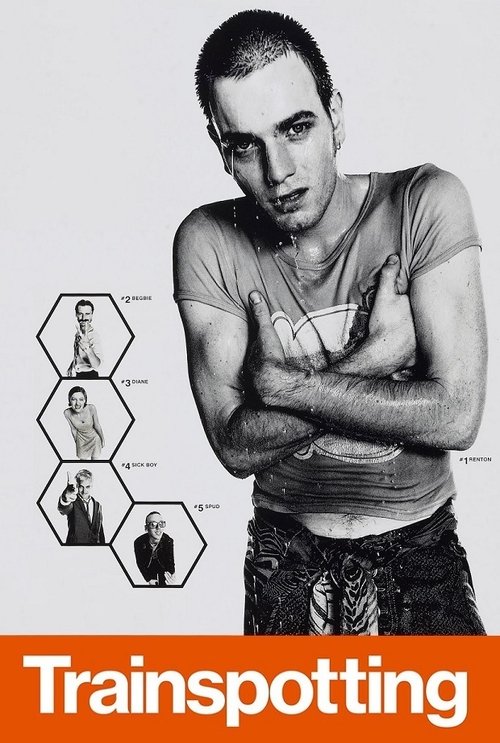
McKay’s style evokes the financial themed, fourth wall breaking style of Martin Scorsese’s The Wolf of Wall Street , but it’s closer in flair to a Danny Boyle film with its frenetic editing and multimedia mash-ups (think Trainspotting and 127 Hours ).
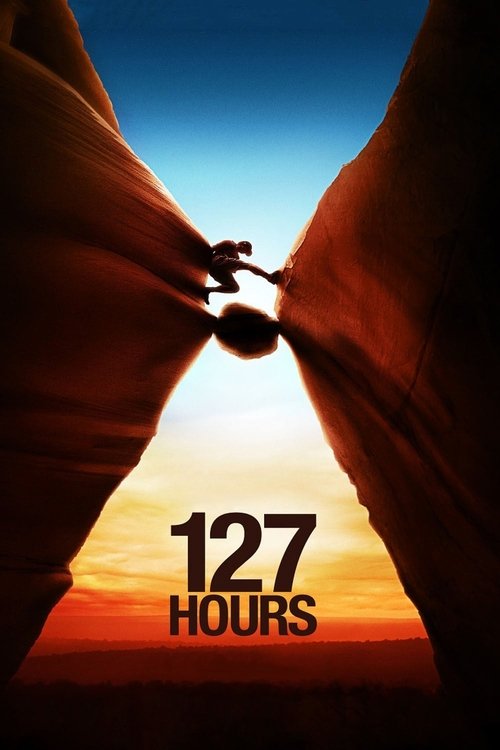
McKay’s style evokes the financial themed, fourth wall breaking style of Martin Scorsese’s The Wolf of Wall Street , but it’s closer in flair to a Danny Boyle film with its frenetic editing and multimedia mash-ups (think Trainspotting and 127 Hours ).
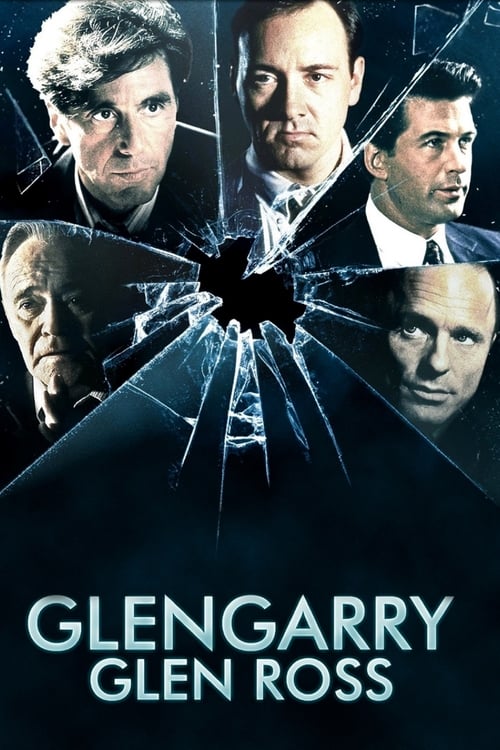
I’ll admit that what I expected, or wanted, was something like “Glengarry Glen Ross,” in which there was lots of tough talk that revealed the toughness of the business.
Excellent too is Ryan Gosling as a fast talking trader whose spiel (with the assistance of Jenga blocks) on the trash value of those subprime bonds that were barley propping the housing market a scene of the year candidate of Glengarry Glen Ross proportions.
The great American tradition of filling one’s pockets with other people’s money has inspired milestones from “Glengarry Glen Ross” to “Ocean’s Eleven,” “Wall Street” and “The Wolf of Wall Street.”
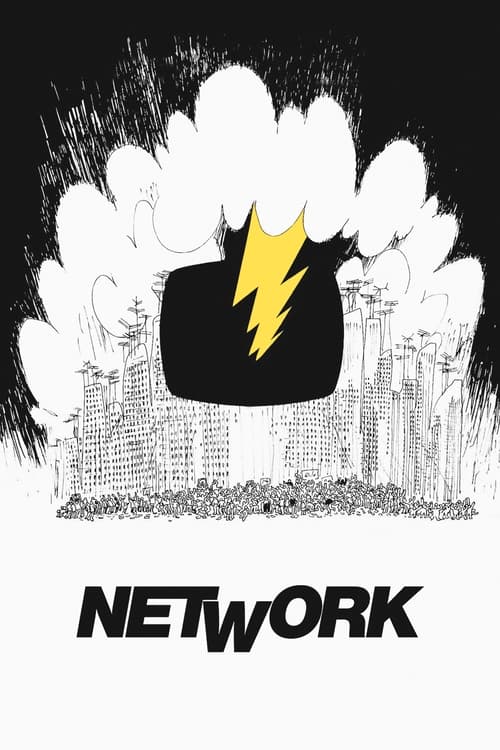
At its best, The Big Short feels a little like a lost script by the great screenwriter Paddy Chayefsky (who penned Network , among many others), filmed in the style of The Bourne Identity .
Ironically, the right's present clarion call comes from liberal Paddy Chayefsky, who wrote in Network (1976), "I'm mad as hell, and I'm not going to take this anymore!"
Advertisement
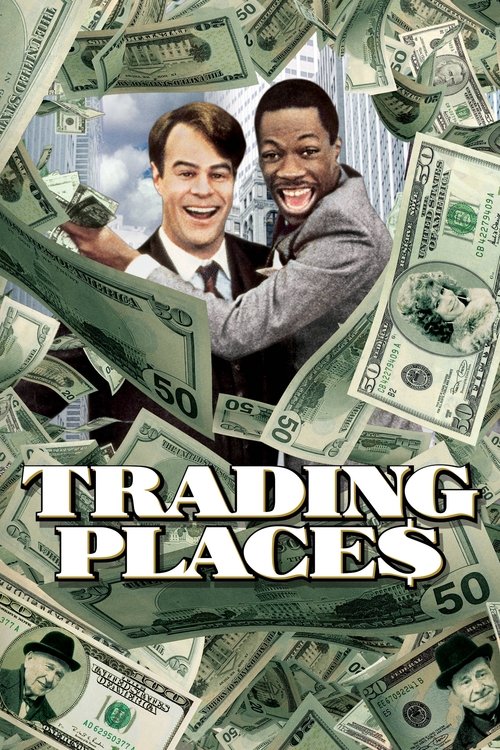
We need Eddie Murphy, in “Trading Places,” looking up at us, just the once, when a rich condescender explains what a B.L.T. is; the look means, “Spare me this old white fool.”
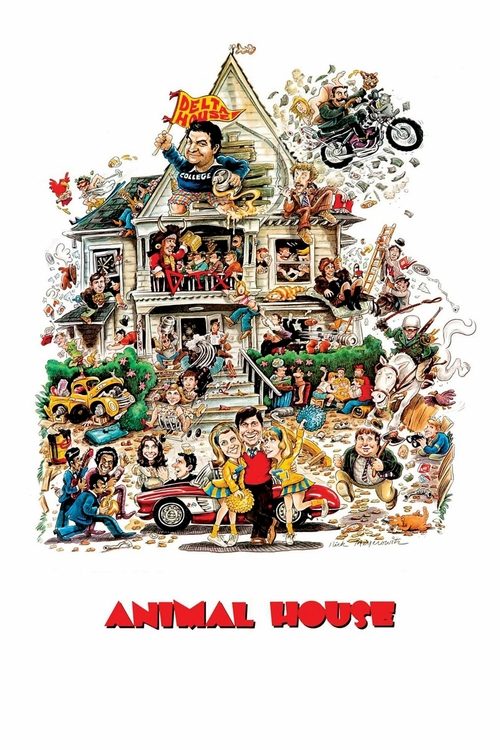
Ask Ivan Reitman, who drew upon years in a college fraternity to help pen Animal House .
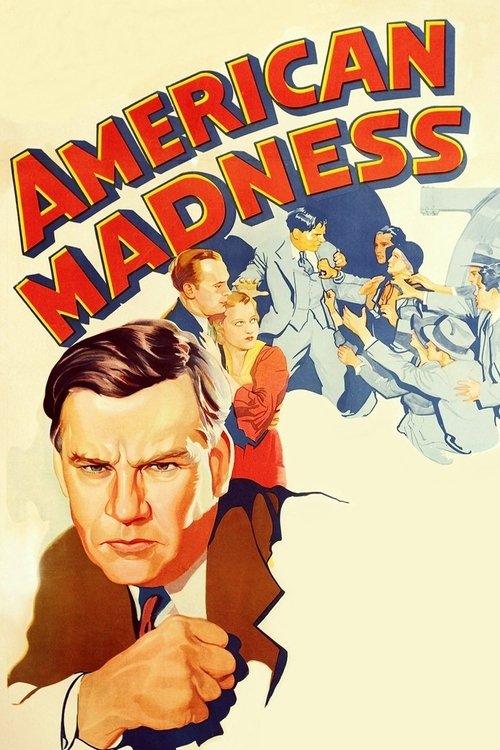
When Frank Capra made “American Madness,” in 1932, with the Wall Street crash fresh in the public mind, he dramatized a run on a bank, taking care not to let the outbreak of chaos send the movie into a spin.