
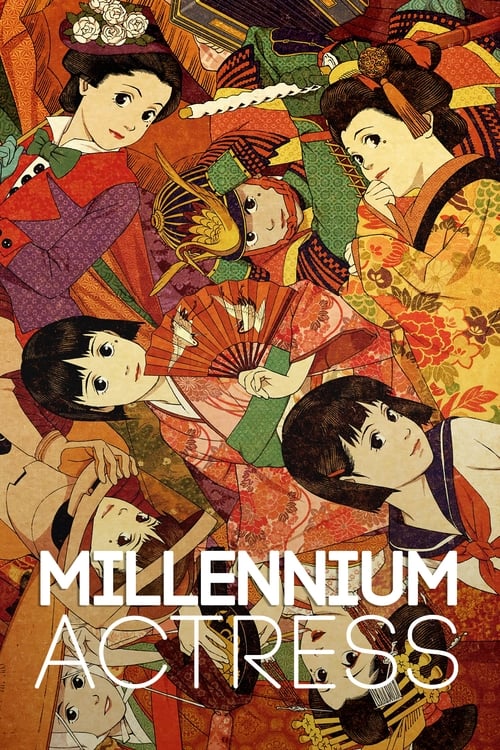
Millennium Actress (2002)
Directed by Satoshi Kon
Documentary filmmaker Genya Tachibana has tracked down the legendary actress Chiyoko Fujiwara, who mysteriously vanished at the height of her career. When he presents her with a key she had lost and thought was gone forever, the filmmaker could not have imagined that it would not only unlock the long-held secrets of Chiyoko’s life... but also his own.
6 connections found
View:
6 connections, in both directions
What critics compared Millennium Actress to



This flourish, fleshed out with footage from Yeoh’s “Crazy Rich Asians” press tour, is par for the course in a movie that invites its most famous cast members to span the entire spectrum of their screen personas, as “Everything Everywhere All at Once” refracts them through the afterimage of their careers with a prismatic dynamism that mirrors the multiverse itself (“Millennium Actress” fans will find this to be one of several different elements that lend Daniels’ film the elastic essence of a live-action anime).


Une caractéristique dont seront également tributaires les tout aussi exceptionnels Millennium Actress et Tokyo Godfathers.
As with their "Perfect Blue," Kon and Murai craft a nonlinear story, interweaving the tale's fact and fiction, treating time as just another element subservient to Chiyoko's yarn.
Millennium Actress, the second anime offering from director Satoshi Kon (who made Perfect Blue in 1997) explores this shifting territory in a style as elegant and epic as the Terminator's is brutish and plodding.
Partially, it's because unlike Miyazaki (whose films are designed for a pretty wide family audience, sometimes skewing a touch older, sometimes a touch younger), Kon's work is comfortably and unmistakably for adults - even when his films aren't as violent and sexual as his debut, 1998's Perfect Blue , they treat on themes and subject matter that is far more mature and complex than Americans want from the cartoons.
And then the room fades to black, and the first, dark light of the newest anime effort of filmmaker Satoshi Kon ("Perfect Blue") comes onscreen, with the first notes of Susumu Hirasawa's wide-ranging classical/techno score.

The dreamscape, the World Wide Web, and the power of the movies to transport viewers to another time and place all combine in Paprika , the latest feature from Japanese anime bigwig Satoshi Kon (Millennium Actress, Tokyo Godfathers), though to say that this film itself actually transports the viewer to a dream-like realm might be pushing it.
In this way, it echoes Kon's "Millennium Actress," in which characters hopped between movies that represented Japan's history.
As he has proved with previous works "Millennium Actress " (2001) and "Tokyo Godfathers" (2003), Kon is a master of the visual and conceptual sensory splurge.
Perfect Blue and Millennium Actress auteur Satoshi Kon’s interest in the flimsy boundary between dreams and reality manifests itself once again in Paprika, a techno-organic fantasia best enjoyed without any preconceived demands for narrative lucidity.
Director Satoshi Kon (Millennium Actress, Tokyo Godfathers) helms a story of reality, nightmares, and the surreal as a madman begins tampering with people's dreams.
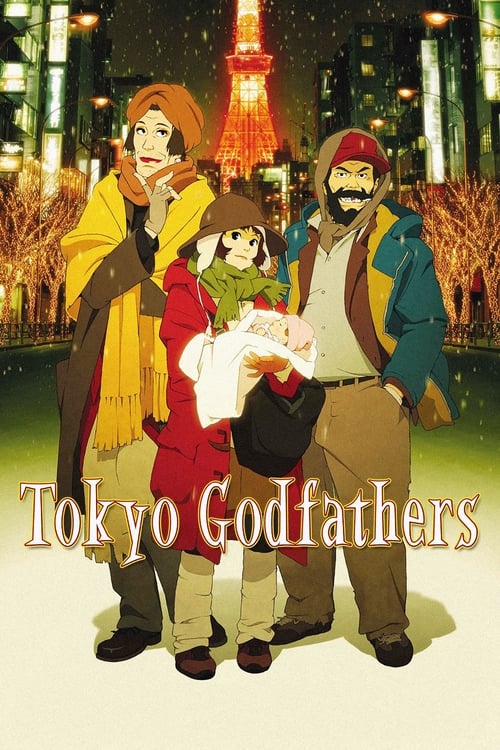
Four years separate Satoshi Kon's astonishing Perfect Blue and his astonishing Millennium Actress; it seems that what the intervening period brought to Kon's palette is a strong sense of visual humour and an affecting pathos to cut the existential dread of his identity crises--the year or two distancing Tokyo Godfathers from Millennium Actress further refining Kon as a humorist even as it blunted his razor's edge.
While neither as visually nor as thematically intricate as Millennium Actress, Satoshi Kon’s Tokyo Godfathers – a reimagining of John Ford’s weepy Western 3 Godfathers in which three homeless friends attempt to return an abandoned baby to its parents on Christmas Eve – is nonetheless a delightfully rambunctious holiday fable about the vital importance of family.
Satoshi Kon follows his meta homage to the movies, Millennium Actress , with a Christmas card to Tokyo’s homeless inspired by John Ford’s religious western 3 Godfathers.
In his first two animated films, Millennium Actress and Perfect Blue, Japanese writer-director Satoshi Kon used the professional illusions of actresses to play subtle, dizzying games with his characters' reality and identity.
But with Kon's clean, anti-cute 2-D style (his cool ''Millennium Actress'' was released in 2002) and alert, dispassionate attention to details of nonmagical, underclass urban life, the stickiness of the premise is cut by a bracing tartness that extends to the lives of the three unorthodox babysitters in their squatters' lair.
If it was not for the ambitious artistry of Satoshi Kon's "Millennium Actress" which made my list of 2003's top 10 films it may have been easier to accept the slight charms of "Tokyo Godfathers," his latest animated feature.

In movies like “Perfect Blue,” “Paprika” and “Millennium Actress,” Kon explored identity’s relationship to the world around these women — the faces they wore in different circumstances that were either wholesale inventions or just them accessing cordoned-off pieces of personality.

There have been many superior producers of anime, led by the late, great Satoshi Kon (“Millennium Actress,” “Paprika”), but the septuagenarian Miyazaki is regarded as Japan’s answer to Walt Disney and gets his films distributed to American art-house theaters.