
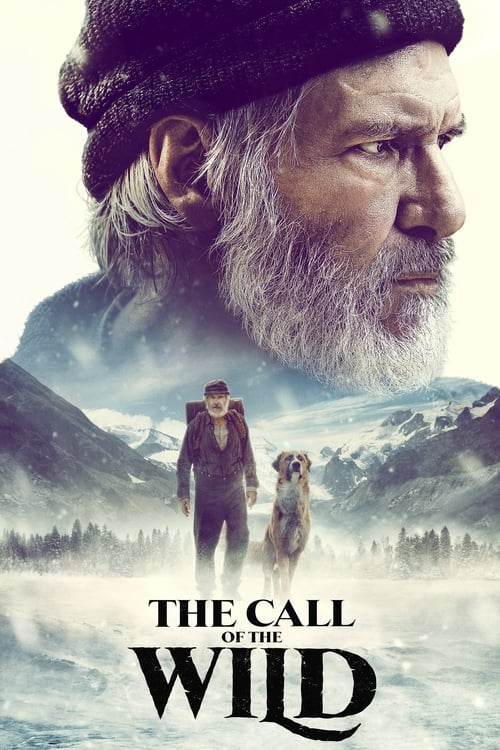
The Call of the Wild (2020)
Directed by Chris Sanders
Buck is a big-hearted dog whose blissful domestic life is turned upside down when he is suddenly uprooted from his California home and transplanted to the exotic wilds of the Yukon during the Gold Rush of the 1890s. As the newest rookie on a mail delivery dog sled team—and later its leader—Buck experiences the adventure of a lifetime, ultimately finding his true place in the world and becoming his own master.
7 connections found
View:
7 films that influenced The Call of the Wild
What critics say influenced The Call of the Wild


This isn’t quite Andy Serkis-level motion capture brilliance ala Planet of the Apes , but you often forget that Buck is a CGI creation throughout thanks to the trick-of-the-mind the film manages.
The final triumph of dog-kind in the film recalls, of all things, Matt Reeves's superlative Planet of the Apes trilogy, postulating a future in which hyper-intelligent, non-human mammals inherit the earth.
Special mention must also be given to actor Terry Notary who was the motion capture reference for Buck, and much like he’s done in the past playing Kong in Kong: Skull Island and Rocket in all three of the recent Planet of the Apes adventures, he adds a layer of emotional authenticity that’s outstanding.
Accomplished motion-capture performer Terry Notary, known for his work on the most recent “Planet of the Apes” films and a thrilling and terrifying ape-inspired performance art piece in “The Square,” brings Buck’s movements to life, and it’s a truly skilled performance.
Terry Notary, the movement coach who taught actors how to mimic simians on the recent “Planet of the Apes” films, played the dog on the set before animation, in what the film bills as a “live action reference performance.”
In the recent Planet of the Apes reboot, the motion capture simians were an ethical alternative to real apes, who shouldn't be exploited for human entertainment.
Much like 1995’s Babe , Buck is given humanistic traits (physical reactions, expressions, etc) that often push the boundary of believability (at one point he convinces Harrison Ford’s gruff, isolated traveller John Thornton to give up drinking), but seeing as how some of the situations Michael Green’s script calls for would be near impossible with an actual dog – animal-on-animal violence, human-on-animal violence, the drastic weather conditions of the icy Canadian setting – the CGI decision, distracting as it may be, makes sense; plus, following the backlash A Dog’s Purpose managed when footage of its animals being mistreated went public, The Call of the Wild ‘s decision is all the more sound.
Although some films with talking four-legged friends - like “Babe” (1995), “The Lion King” (2019) or even “The Cat from Outer Space” (1978) - have a nestled place in moviedom, thankfully in “The Call of the Wild”, the computer-constructed pooches - including our sympathetic hero - behave like dogs and aren’t asking one other, “Hey, when will we break for dinner?”

The adaptation of Jack London's 1903 novel is part of a mini-boom of Lit 101 adaptations, coming after the $200 million success of Little Women and before upcoming versions of Jane Austen's Emma and Charles Dickens' David Copperfield.
Relying on the same fusion seen in the hybrid live-action/animation versions of The Jungle Book and The Lion King, director Chris Sanders (How to Train Your Dragon) sometimes veers toward a Disneyfication of the source material, with souped-up, special-effects-laden stunts and lots of kooky canine slapstick.
Whilst director Chris Sanders ( Lilo & Stitch , How to Train Your Dragon ) does indeed put the dog in question (Buck) in perilous situations, and it would be best noted that the violence in some scenes suggests physical abuse towards said dog too (the material is perhaps a bit too distressing for younger viewers), the evolution of Buck as a character outweighs any of the could-be-traumatic material.
That’s because “The Call of the Wild,” directed by Chris Sanders (the co-director, with Dean DeBlois, of “How to Train Your Dragon” and “Lilo & Stitch”), is a semi-live-action film that nevertheless bounces along with the glibly overdone visual logic of an old Disney dog comedy from the 1960s.
This is Sanders’ live-action directorial debut after the filmmaker cut his teeth co-directing Disney’s Lilo & Stitch and DreamWorks’ How to Train Your Dragon to critical acclaim.
Sometimes director Chris Sanders (How to Train Your Dragon) plays it safe where he shouldn’t have, though.
This is Sanders’s live-action debut, having made a name for himself in the animation world with films like Lilo & Stitch and How to Train Your Dragon .
Advertisement
Much like 1995’s Babe , Buck is given humanistic traits (physical reactions, expressions, etc) that often push the boundary of believability (at one point he convinces Harrison Ford’s gruff, isolated traveller John Thornton to give up drinking), but seeing as how some of the situations Michael Green’s script calls for would be near impossible with an actual dog – animal-on-animal violence, human-on-animal violence, the drastic weather conditions of the icy Canadian setting – the CGI decision, distracting as it may be, makes sense; plus, following the backlash A Dog’s Purpose managed when footage of its animals being mistreated went public, The Call of the Wild ‘s decision is all the more sound.
At parts, it feels more like A Dog’s Purpose film than the gritty wilderness tale of London’s original book.
And we wouldn’t have movies like Old Yeller, Marley & Me and A Dog’s Purpose without it.
Much has already been made about the decision to make heroic dog protagonist Buck an FX creation, and although this means that a flesh-and-blood mutt doesn’t have to be lengthily and expensively trained, and PETA (People for the Ethical Treatment of Animals) didn’t condemn the finished product (as they did with, for example, A Dog’s Purpose ), it also results in Buck never looking like he’s actually there .
The family-friendly adventure is the latest in a recent run of movies with a canine protagonist, which includes “A Dog’s Purpose,” “A Dog’s Way Home,” and “The Art of Racing in the Rain.”
Gone is the savage romance of London’s short novel in all its untamed glory, instead, The Call of the Wild is a Disney-fied The Revenant — though it’s even less a survival film than it is a schmaltzy celebration of that bond between dog and human.
Chris Sanders has decades of experience with animation, including writing credits on Aladdin (1992), The Lion King (1994), Mulan (1998), Lilo & Stitch (2002), and How to Train Your Dragon (2010).
Directed with an intuitive and obvious love of dog movie lore by Chris Sanders ( Lilo & Stitch ; How to Train Your Dragon ; The Croods ; he also wrote a swag of Disney mega-hits such as Beauty and the Beast , The Lion King and Mulan ) the film really pays out on traditional dog movie chestnuts such as friendship, loyalty, survival and character-forming journeys.