
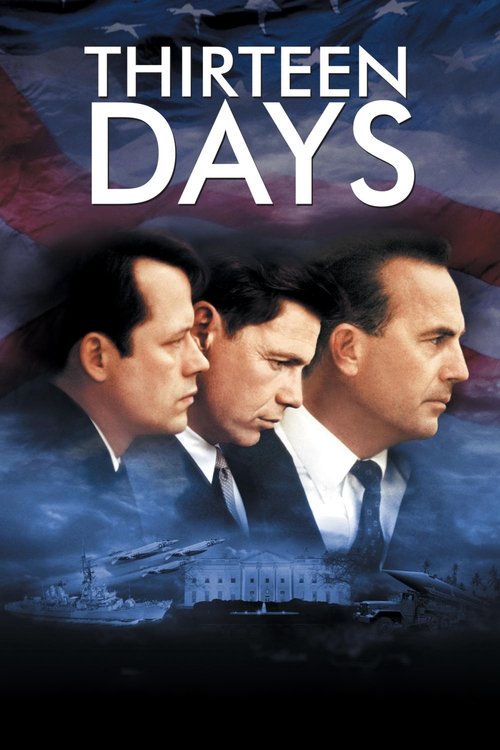
Thirteen Days (2000)
Directed by Roger Donaldson
The story of the Cuban Missile Crisis in 1962—the nuclear standoff with the USSR sparked by the discovery by the Americans of missile bases established on the Soviet-allied island of Cuba.
7 connections found
View:
7 connections, in both directions
What critics compared Thirteen Days to


Cuban Missile Crisis docudrama Thirteen Days on the BOATS (Based On A True Story) end of things…
These generic bureaucratic faces seem vacant compared with those in Advise and Consent, Seven Days in May, Twilight’s Last Gleaming, and Thirteen Days…
The movie that might come closest is Roger Donaldson’s Thirteen Days…

The Wolfman was written by David Self and Andrew Kevin Walker, who both cut their teeth on some terrific, heady movies -- Walker on dark genre films like Se7en and Sleepy Hollow, and Self on Thirteen Days and Road to Perdition.
Adapted from Curt Siodmak’s original script by Andrew Kevin Walker (“Se7en,” “Sleepy Hollow”), then totally re-written with ludicrous, clichéd lines of dialogue by David Self (“Road to Perdition,” “Thirteen Days”) it’s unfortunately unfocused, conflicted and bizarrely edited.
Theoretically a remake of the 1941 genre-defining Lon Chaney, Jr. vehicle The Wolf Man (please note the subtle distinction between the titles), the new film, written by Andrew Kevin Walker and David Self - the former man at least has some respectable credits, while the latter vomited out Thirteen Days and the 1999 remake of The Haunting - borrow little from Curt Siodmak's original scenario besides character names and the set-up that a prodigal son has returned to his ancestral home in Great Britain on the event of his elder brother's violent death (the remake doesn't even leave the action in Wales).
Adapted and fleshed out by screenwriter David Self ("Thirteen Days," "The Haunting") from Max Allan Collins and Richard Piers Rayner's original graphic novel, the film tells the tale of a Depression era hitman who goes on the run from the mob with his only surviving son after a corrupt mob figure kills the rest of his family.
David Self, who previously wrote the focused "Thirteen Days" and the out-of-control "The Haunting," has made some very shrewd changes to the original that increase its emotional wattage.
Surely the ingredients are all in place for a moving epic: "Beauty" cinematographer Conrad L. Hall paints each frame with delicate swaths of light and shadow, "Thirteen Days" screenwriter David Self follows the path of the classic tragic morality tale, and 12-year-old newcomer Tyler Hoechlin convincingly portrays a conflicted son without a hint of preciousness.
The story, written as a graphic novel by Max Allan Collins and Richard Piers Rayner, and adapted into the screenplay by David Self (who also penned the excellent Thirteen Days ), the story takes place in 1931, at the height of prohibition, the Depression, and, if you'll pardon the pun, mob rule.
Screenwriter David Self ( Thirteen Days ) adroitly expands and deepens the original tale put forth in Max Allan Collins and Richard Piers Rayner's graphic novel while staying true to the pulpy comic-book source material (and its inspiration, the Japanese samurai comic "Lone Wolf & Cub"), yet too many crucial scenes have the ring of predictability.
But screenwriter David Self (Thirteen Days) has retained the propulsive narrative energy of Collins's novel, even as he has expunged its pulpier aspects (which are effective enough in comic-book form but difficult to translate to the screen with a straight face).

She's the boss of the Golden Circle, the world's No. 1 drug cartel who, in the course of things, essentially blackmails the (equally conniving) U.S. president (Bruce Greenwood, who 17 years ago played JFK in Thirteen Days) into legalizing drugs.
Advertisement
My ears are still bleeding from the accents in "Thirteen Days" and "Blown Away" and it's nice to hear some authentic sounds.
"Dragonfly," starring Kevin Costner ("Thirteen Days"), and directed by Tom Shadyak ("Liar Liar") is a film bogged in quicksand until the final 20 minutes or so, when it finally gets interesting.
One of the film's bigger problems, however, is with lead actor Kevin Costner ("3000 Miles to Graceland," "Thirteen Days").
Although he has had his share of successes, e.g., Dances With Wolves, JFK, and Thirteen Days , he has also been responsible, or at least partly responsible, for the likes of Waterworld, The Postman , and For Love Of The Game .
Whether attempting to widen his range (playing a psychotic Elvis impersonator in "3,000 Miles to Graceland") or harking back to former glories (the " JFK "-style " Thirteen Days "), he can't seem to recapture the alchemy of " The Untouchables " and "Dances With Wolves".

She's accompanied by her Commander Robert Iverson (Bruce Greenwood, "Thirteen Days") who marks his days as numbered when he advises her 'You're not a leader until you've lost.'