
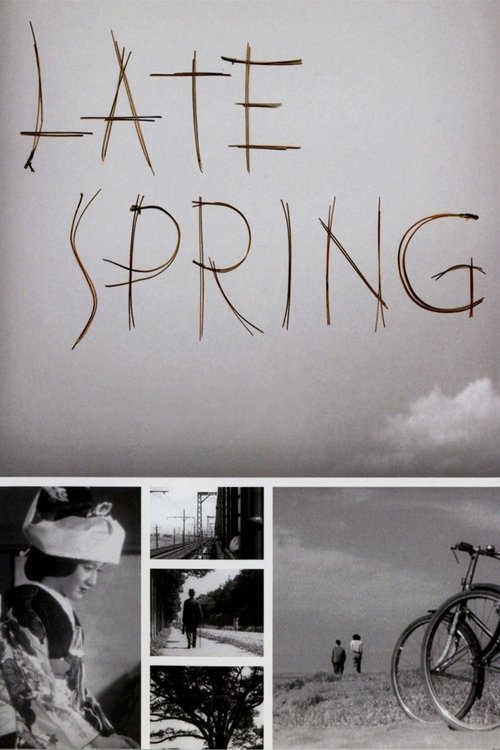
Late Spring (1949)
Directed by Yasujirō Ozu
Noriko is perfectly happy living at home with her widowed father, Shukichi, and has no plans to marry -- that is, until her aunt Masa convinces Shukichi that unless he marries off his 27-year-old daughter soon, she will likely remain alone for the rest of her life. When Noriko resists Masa's matchmaking, Shukichi is forced to deceive his daughter and sacrifice his own happiness to do what he believes is right.
2 connections found
View:
2 connections, in both directions
What critics compared Late Spring to



Denis is known for the tender father-daughter relationship depicted in her 35 Shots of Rum (a retelling of Ozu’s Late Spring), but she more recently took up the theme in Bastards, her 2013 adaptation of Faulkner’s Sanctuary that reaches a horrifying and incestuous conclusion.
It is not, in fairness, the only perfect film made by director Ozu Yasujiro: there are no quantitative ways to measure the difference between it and Late Spring , and I wouldn't bat an eye at the suggestion that his final two films (both in color), The End of Summer and An Autumn Afternoon , are more accomplished than either.
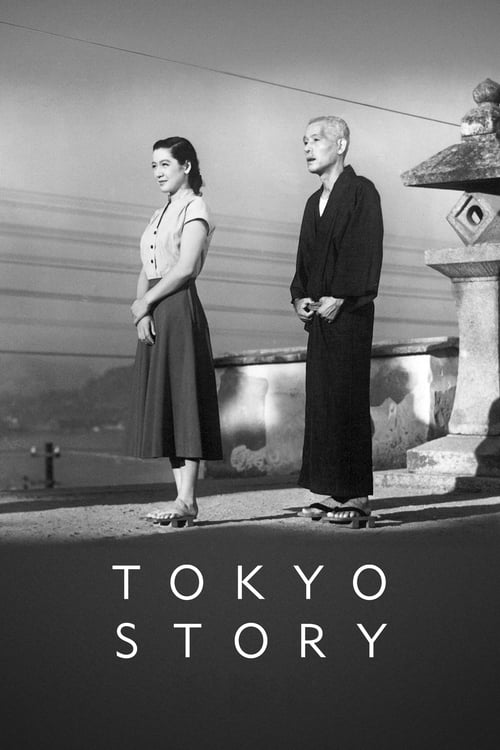
Perhaps the most powerful such moments are conveyed by Setsuko Hara in Ozu's two most celebrated films, 1949's Late Spring and 1953's Tokyo Story, both of which are presented in limited runs this week.
“Tokyo Story” was voted the third greatest film of all-time in the 2012 Sight and Sound poll , just behind “Vertigo” and “Citizen Kane,” and the inclusion of “Late Spring” at number 15 makes Ozu the only director with two entries in the top twenty (Coppola and Dreyer were close).
This film may be concerned with time (and its chief symbol may be Tomi’s old-fashioned, albeit still ticking, timepiece), but Ozu’s carefully framed, quietly sedate mise-en-scène makes Tokyo Story seem timeless – an effect aided by some masterfully understated performances, as Ryu and Hara, ringing the changes on roles that they had already played in Ozu’s Late Spring and Early Summer , both show the full range of human emotions that can be concealed behind a smile.
Reductive critics may protest that he made virtually the same films again and again, and in this regard, Tokyo Story may not be any "better" than, say, There Was a Father or Late Spring or Early Summer, but in such stellar company, hierarchies become meaningless and subtle differences become everything.
Some of these films include Late Spring (Banshun, 1949), Early Summer (Bakushu, 1951), Floating Weeds (Ukigusa, 1959) and An Autumn Afternoon (Sanma no aji, 1962).