
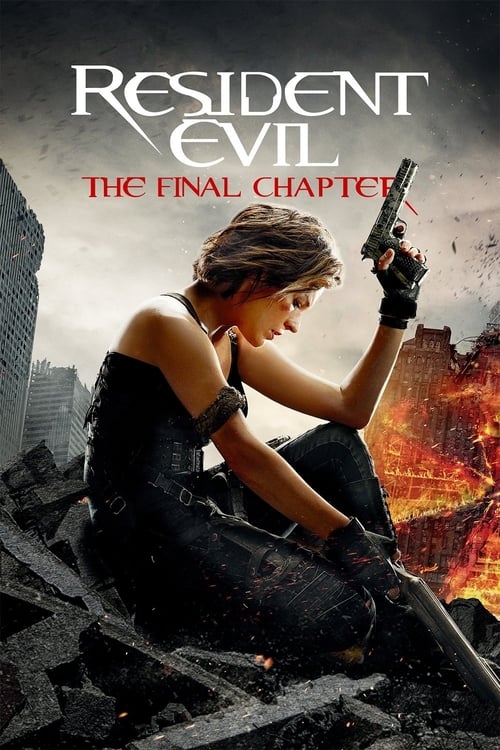
Resident Evil: The Final Chapter (2016)
Directed by Paul W. S. Anderson
Picking up immediately after the events in Resident Evil: Retribution, Alice is the only survivor of what was meant to be humanity's final stand against the undead. Now, she must return to where the nightmare began - The Hive in Raccoon City, where the Umbrella Corporation is gathering its forces for a final strike against the only remaining survivors of the apocalypse.
5 connections found
View:
5 films that influenced Resident Evil: The Final Chapter
What critics say influenced Resident Evil: The Final Chapter



In addition to repurposing situations, character types, and fight choreography from previous episodes, Anderson borrows freely from a host of other post-apocalyptic action-adventures — most notably, “Mad Max: Fury Road” — while charting Alice’s progress as she and a ragtag team of like-minded heroes (including series semi-regular Ali Larter) battle zombie hordes and Umbrella Corporation minions that stand in the way of their mission.
Her mission, which comes with a 48-hour deadline and often plays out with more than a few nods to Mad Max: Fury Road: find an airborne antivirus that can save the last survivors from extinction.
In Resident Evil: The Final Chapter, for instance, there's an elaborate and sporadically exhilarating battle sequence that brings to mind portions of The Lord of the Rings: The Two Towers and Mad Max: Fury Road merged with the frequently quoted bible of Anderson's oeuvre, Aliens .
But the rapid-fire aesthetic has its moments—namely, a highway battle that shows the influence of Mad Max: Fury Road and a crazed, fiery siege sequence that pits Alice and a group of Raccoon City survivors against an easily distracted army of hungry zombies that seems to number in the hundreds of thousands.
Some of the set-pieces that follow – especially one where Alice is captured and literally made to run for her life – suggest that Anderson has taken a long hard look at George Miller's recent Mad Max: Fury Road, the current gold standard for post-apocalyptic action cinema.
Y con esto bastaría para darle una oportunidad, pero voy más allá: es una cinta de acción extrema con tomas que a veces hasta marean, balazos casi cada segundo, personajes estereotipados y diálogos ridículos, edición totalmente vertiginosa, brincos algo ilógicos de locación y en el tiempo, acrobacias espectaculares, criaturas asquerosas (entre las cuales hay ¡zombis!), giros de tuerca y ambientación que a momentos les recordará a Mad Max: Fury Road.
Como aquella tercera parte, lo nuevo del tándem formado por Jovovich y Anderson está plagado de homenajes, convirtiendo la cinta en un recorta y pega ensamblado con tino y espíritu de cine de barrio en el que se citan títulos como Robocop (atención con el momento OCP: está usted despedido), Doomsday - El día del juicio o Helldriver (sí, han leído bien, la cima épico-gore-digital de Yoshihiro Nishimura), y series de televisión como Juego de Tronos (esperen dragones, catapultas gigantes y un trasunto del fuego valyrio) y la disparatada y genial Z Nation (el niño zombi en el funicular y en general todo lo referente a los muertos vivientes).
Unlike someone like Kate Beckinsale , whose general contempt for the “Underworld” franchise can be detected whenever she is on screen, Jovovich is clearly having a blast doing these films.
As with the recent edition of the similar Underworld franchise, the film begins with a recap of what’s gone on before, which seems less designed for newcomers than viewers who’ve actually seen the previous entries but can’t remember a thing about them.
For what it’s worth, this saga is a brand-leader in its field – consistently more entertaining than the Underworld films and leaving non-starters like Aeon Flux, Ultra Violet and Priest in the dust.
Somewhere around part three or four, however, the dumb fun turned into incomprehensible nonsense, weaving plot strands that involved clones, superpowers, implanted memories and various other unnecessarily convoluted, hacky plot devices that rendered the series almost as confusing and inert as Underworld.
With six evils tucked under her belt, Jovovich surpasses Underworld‘s Kate Beckinsale, who has only made five to date, and the Alien franchise’s Sigourney Weaver.

To obtain it, Alice teams up as usual with a ragtag group of survivors, including Claire (Ali Larter, from four previous movies), and Abigail (Ruby Rose, who after this and Vin Diesel’s xXx really ought to consider changing agents).
Advertisement
In Resident Evil: The Final Chapter, for instance, there's an elaborate and sporadically exhilarating battle sequence that brings to mind portions of The Lord of the Rings: The Two Towers and Mad Max: Fury Road merged with the frequently quoted bible of Anderson's oeuvre, Aliens .