
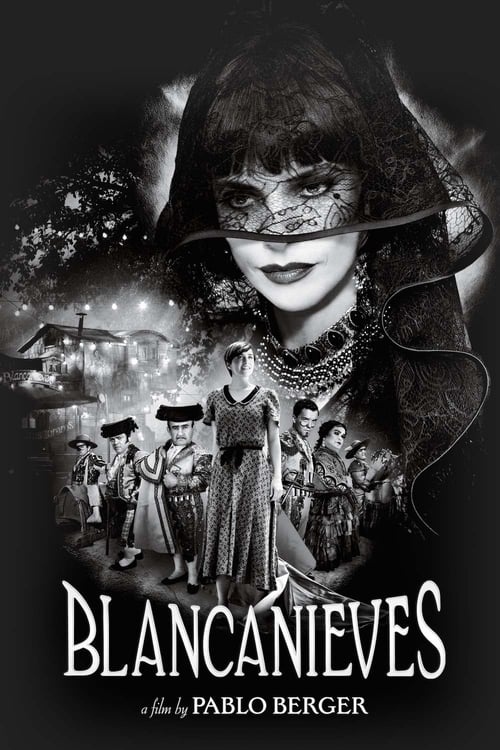
Blancanieves (2012)
Directed by Pablo Berger
A black and white silent movie, based on the Snow White fairy tale, that is set in a romantic version of 1920s Seville and centered on a female bullfighter.
6 connections found
View:
6 connections, in both directions
What critics compared Blancanieves to



It is shamelessly derivative, raping countless sources to come up with what is essentially a limp riff on the Tolkien quest married to things as divergent as The Living Daylights, all three original Star Wars films, all three Indiana Jones films, Gulliver's Travels, The Bible, Masters of the Universe, and Disney's Snow White and the Seven Dwarfs.

Nearly 80 years after "Snow White," the old Disney factory is still crankin' 'em out better than anyone.
The studio is still following the broad parameters it started laying down in 1937, with Snow White a nd t he Seven Dwarfs , by reshaping a culturally specific fairy tale to fit a family-friendly, accessible template.

Or, perhaps more hopefully, Disney is subtly signaling the long overdue end of one of its recurring motifs—that of the evil, older woman playing the embittered foil, a tradition almost unbroken from “Snow White” through “Sleeping Beauty” and even up to “The Little Mermaid.”

This fulfills the rule of seven, an ancient storytelling maxim that can be found in everything from Snow White to Gilligan’s Island to The Magnificent Seven.
Advertisement

Walt Disney PIctures Anna, Olaf and Kristoff from Walt Disney Pictures' Frozen (2013) Ever since “Snow White,” the cute craftsmanship of Disney cartoons has blotted out the homicide and sorcery in the source material, which is often the folklore of central Europe.
Disney is at its best when it’s working with classic stories and/or fairy tales (think “Aladdin,” “Beauty and the Beast,” “Snow White” and “Cinderella”).

Walt Disney at his most sentimental — think the pastoral Technicolor nature scenes for Snow White and Bambi —couldn’t have tweaked the Fury Road color scheme to make it any prettier.