

The Mother and the Whore (1973)
Directed by Jean Eustache
Aimless young Alexandre juggles his relationships with his girlfriend, Marie, and a casual lover named Veronika. Marie becomes increasingly jealous of Alexandre's fling with Veronika and as the trio continues their unsustainable affair, the emotional stakes get higher, leading to conflict and unhappiness.
4 connections found
View:
4 connections, in both directions
What critics compared The Mother and the Whore to
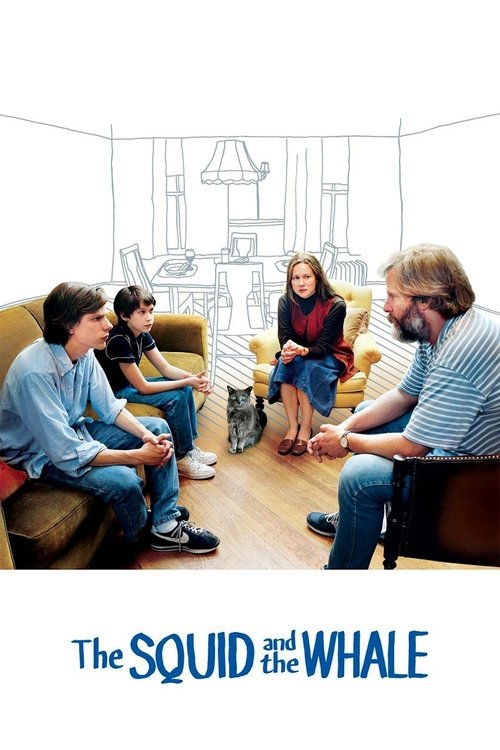


What do a tennis match, writing desks for “lefties,” A Tale of Two Cities, and Jean Eustache’s The Mother and the Whore have in common?
(Its sparse decor includes a poster for director Jean Eustache's epic of sexual angst, "The Mother and the Whore.")
Jean-Luc aside, Baumbach's model here is arguably Maurice Pialat and, less arguably, Jean Eustache, whose seminal bleeding wound, The Mother and the Whore, gets a cinephilic shout-out -- harrowing domestic dissection, emotional rawness, the artist's exorcizing-feeding upon his own upheavals.
At times, Baumbach's film slips into self-appreciating shorthand, as when the camera notes the movie poster in Walt's bedroom, for The Mother and the Whore, or he runs off to find the diorama of eternal, gargantuan struggle in the Museum of Natural History that grants The Squid and the Whale its unsubtle title.
Shot in grainy 16mm and fluidly cut, The Squid and the Whale adheres to the purity of the best of the New Wave as embodied by The Mother and the Whore poster on Walt�s wall.
And only in his decision to adorn scenes' backgrounds with obvious signifying novels (Bernard reading Saul Bellow's The Victim) and movie posters (Walt's one-sheet for The Mother and the Whore) does Baumbach's general directorial tact and understatement falter, a somewhat surprising shortcoming considering his delicate employment of lyrical pop song accompaniment to underscore the tumultuous action.
For viewers of Eustache's The Mother and the Whore (La Maman et la putain) (1973) or almost any of Philippe Garrel's films, '68 might seem to have been a moment so cataclysmically beautiful and tragic as to be unfilmable.
One reason is the running time: This black-and-white movie, which is made up mostly of people talking in small, cluttered hippie pads, is longer than "Titanic" and just a few minutes shorter than "Gone With the Wind."
The character was played by Jean-Pierre Leaud , star of " The 400 Blows " and two other autobiographical films by Francois Truffaut .
Jean-Pierre Leaud, who spent years trying to match the brilliant work he did as the 12-year-old hero of Francois Truffaut's "The 400 Blows" (1959), turns in the performance of his career.
Jean-Pierre Leaud has been acting in films for 40 years now, since he played the adolescent delinquent of Truffaut’s “The 400 Blows,” and this film may well be the most important of his career; the same goes for his co-stars.